
Jose Antonio Rueda: “I didn’t think consistency in Moto2 would come so quickly”
30/07/2026The reigning Moto3 World Champion reflects on a first half of the 2026 season that wasn’t easy after landing in the intermediate class.
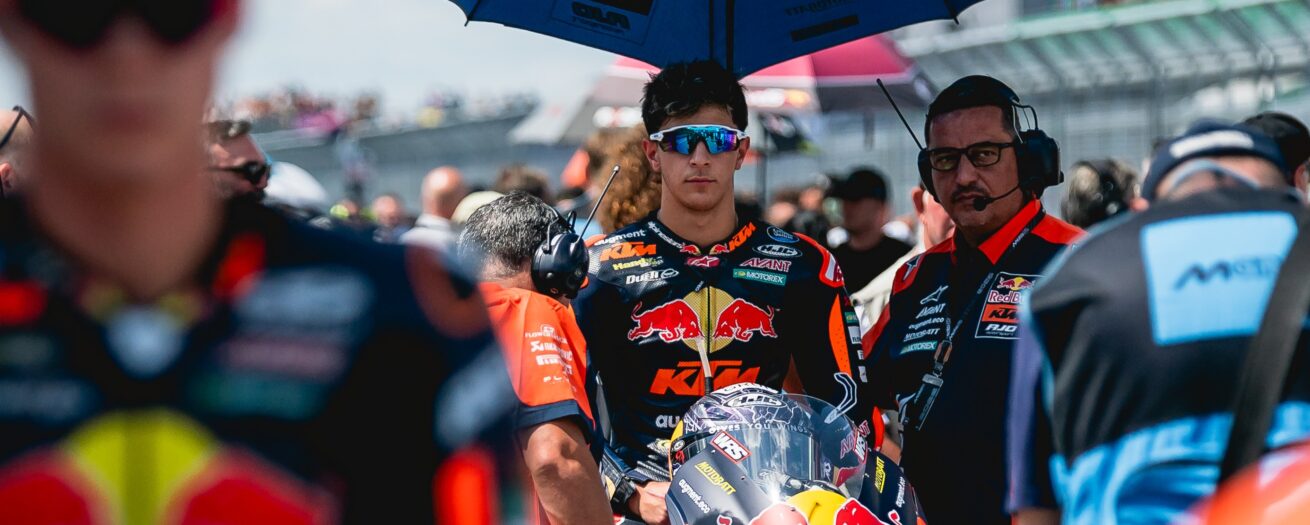
Jose Antonio Rueda currently leads the Rookie of the Year standings in the Moto2 World Championship, despite an injury at the end of 2025 that complicated his arrival in the intermediate class. The reigning Moto3 World Champion achieved his best result in the series just before the summer break, with eighth place at the German Grand Prix, and is hoping for more in the second half of 2026.
– Last year we discussed about your regularity. Now, after finding some consistency in Moto2, do you consider it the most fundamental thing for you?
Yes, without a doubt. It’s the most important thing here in the World Championship, because we compete over a long period of time across many different circuits that vary significantly from one another. Being competitive under such diverse conditions is the tricky part of racing at this level, and to always be up there fighting at the front is no easy task. Everything can change from one weekend to the next, from your physical and mental state to the weather conditions -not to mention the specific characteristics of each circuit or country. For me, it is by far the most fundamental aspect, especially now that the seasons are getting longer and longer.
– During the preseason, you jumped on the Moto2 bike later than all your rivals. What was it like going through the recovery and adaptation processes simultaneously?
It’s quite a tricky situation. To be honest, it’s something I wouldn’t wish on anyone. The opening races of the year were really tough for me, so managing it all was far from easy. After becoming the Moto3 World Champion following a great 2025, adapting to a new set of circumstances is a bit of a challenge. Obviously, you know from the start that Moto2 is tough, but until you experience it firsthand, you don’t fully grasp just how difficult it is -especially without having had a preseason due to injury. Regardless, as I’ve said many times, that’s no excuse. The circumstances were what they were, and everything happens for a reason, so I don’t want to dwell on it. Since the French Grand Prix, we’ve been doing a good job on the bike, and that’s the key takeaway. Whenever I’ve been able to give 100%, I think that step forward has been noticeable, and that’s what matters when you’re going through a learning and adaptation process like this one.
-You’re still working as you always did in Moto3: alone and without references. What aspects of your riding style have you had to change the most?
It’s good to have a solid foundation in terms of your working methodology. Moto2 is a class where your pace counts for a lot, and you don’t achieve that just by following other riders. That’s fine for chasing a lap time, but it’s vital to work alone -just as we always did in Moto3- especially to see what I’m doing right and what I’m lacking or need to change. I find working on my own really helps me identify the things I need to adjust. In fact, in France, we noticed several details regarding my riding style, particularly on right-hand corners. I was handling left-handers well, but we saw that wasn’t the case for right-handers, so we had to correct some details. That isn’t easy when you’re already deeply accustomed to certain styles or movements.
-Do you think the maturity gained in 2025 has helped you better manage your transition to Moto2?
I think what really helped me mature in the World Championship -more than 2025- were the two preceding years. Especially 2024, when we had to learn a great deal, both personally and professionally. In fact, thanks to how we handled that period, we were able to handle the start of 2026 much better, particularly from a mental standpoint. Things didn’t get off to a good start this season, but we managed to turn the situation around, and now we’re in much better shape. Without a doubt, Moto2 remains a very tough class where everything can change drastically from one weekend to the next. But you have to stay strong and be ready for whatever comes your way.
“I think what really helped me mature in the World Championship -more than 2025- were the two preceding years”
-You said that the things changed that much during the FrenchGP. How crucial was it to undergo surgery for compartmental syndrome?
Honestly, I didn’t realise the issue with my right arm was so serious. At first, I thought it was all concentrated in my hand, but it was more in the arm itself. Perhaps it could have been detected sooner, but the important thing is that we identified one of the key factors that has helped me keep working and learning.
-After Le Mans, you finished 4 out of 5 races into the points, with some appearances into the Q2 also. Did you expect your current level of consistency to come so quickly?
I didn’t think it would happen so fast -especially in such a tough class. After France, we spotted something that really helped us take a solid step forward, but I didn’t expect to make that leap so quickly. In Barcelona, we managed to reach Q2 for the first time and qualify ninth; I remember that as a weekend in which we learnt a lot, because we showed consistency over two consecutive Grands Prix and started to really believe in ourselves. In Moto2, you can never get complacent because everyone is fast and the field is incredibly tight, but when you see yourself repeating positive results back-to-back, your perspective changes. Of course, now we have to keep working, keep moving forward, make Q2 more often, and fine-tune the details we struggle with most.
-You’re sharing box now with Collin Veijer, with one more year of experience in the class than you. How has having him in the garage helped you?
I’m really happy to have a teammate like Collin. We’ve gotten along well for years; we’ve known each other and raced together since our minimoto days, so having him alongside me is very rewarding. He is a rider I can learn from, both on and off the track, so having him on the team during my first year in Moto2 has been very positive; I think he is one of the best teammates I could possibly have. We were battling against one another at the Czech Grand Prix, and that gives me extra confidence. Obviously, we both race to win, but it really motivates me to be able to learn from him going head-to-head on Sundays; he is a very fast rider, and that helps me keep improving.
-At the beginning of the year, you didn’t want to think too much in specific goals. What is your mindset for the second half of the season?
Honestly, I don’t have anything specific in mind. I want to keep working the way we have been, become more competitive in our weaker areas, and be a more well-rounded rider overall. Once we achieve that, I think we can start thinking about more concrete goals. But right now, since it’s my first year, I want to enjoy riding the bike, learn as much as possible, work hard with my team, and try to do my best in every race. Consistency remains the hardest part and brings the greatest reward, so I need to keep going. That doesn’t change the fact that I’m very happy with how the first half of the season has gone, especially since the French Grand Prix, so I’m really looking forward to tackling the second half of 2026.
With the excellent result at Sachsenring – his second Top 10 finish of the season – Rueda has further fitted his name in the category, with half of his debut season still to come. Sitting 16th in the standings with 27 points and the rookies lead, the Red Bull KTM Ajo rider is focused now on consolidating its position in the Top 10 or 15 in every race. The Spaniard will be back in action next week at the legendary Silverstone circuit, where the series resumes on August 7-9th with the British Grand Prix.